

HOW TO CHOOSE YOUR BONE CONDUCTION HEADPHONES FOR RUNNING?
For running with music, Bluetooth bone conduction headphones are one of the best options available! You just need to choose the right model. Follow our guide to find the headphones that suit you.

Bluetooth headphones vs wired headphones
Today, the vast majority of sports headphones use a wireless connection. Bluetooth technology has become the standard, and it is worth understanding why this change is good news for runners.
Why has Bluetooth become the standard?
Bluetooth running headphones have become the standard, particularly because they free athletes from anything that could restrict their movement. No more wires getting tangled or pulled out during sudden movements. During sports sessions, freedom of movement is essential! Whether using bone conduction or in-ear technology, Bluetooth headphones and earphones also offer better product durability and improved comfort during and outside exercise.
Bluetooth, an ally for comfort and convenience
Bluetooth allows quick pairing with a GPS sports watch, smartphone or MP3 player. It provides a stable and seamless connection, so you never lose your rhythm! Bluetooth also allows hands-free calls, making bone conduction headphones useful far beyond running sessions: walks, remote working, and more. Some headphones even allow you to control the volume or change tracks directly using touch controls.
Bluetooth for longer battery life
The latest generations of Bluetooth bone conduction headphones are designed for long outings. Manufacturers integrate high-performance batteries capable of providing 6 to 10 hours of continuous listening. Some models, such as the Shokz OpenRun, even offer fast charging options: perfect for runners in a hurry!
Are wired headphones completely outdated?
Today, very few wired headphones are still designed for running. Why? Because they come with too many constraints: cables bouncing around, the risk of being pulled out, premature wear around the connectors… Choosing Bluetooth headphones or earphones for running, whether on trails or roads, is a matter of comfort, but also safety, thanks to the development of bone conduction headphones. We will explain why below.
Bone conduction headphones: how do they work?
Bone conduction is a technology that can seem intriguing at first. However, it is both simple and effective, with tangible benefits for runners.
What is bone conduction?
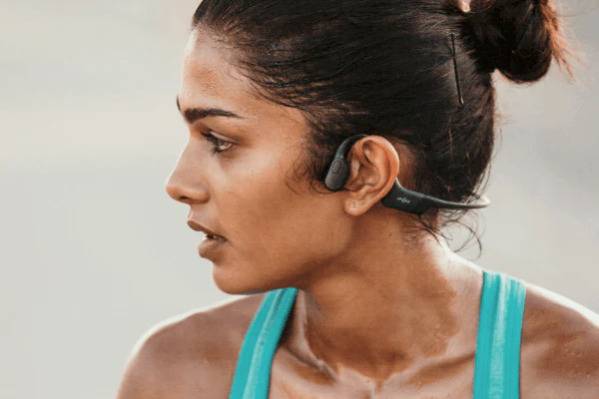
Unlike conventional headphones, which send sound through the ear canal, bone conduction headphones transmit vibrations directly to the inner ear through the bones of the skull, mainly the cheekbones and jaw. As a result, your ears remain open, allowing you to stay alert and aware of your surroundings. You can hear your music clearly while also remaining aware of external sounds such as cars, bicycles and pedestrians. This is a real advantage for safety! This technology is particularly well suited to runners training in urban environments.
Bone conduction headphones vs in-ear headphones
On the one hand, in-ear headphones offer a more immersive listening experience. On the other, bone conduction headphones allow you to maintain greater awareness of your surroundings because your ears remain open. For running, especially in cities or on paths, we strongly recommend bone conduction. The listening experience is admittedly different, but you get used to it very quickly, and the latest models offer accurate sound reproduction and powerful bass. Most importantly, they also help avoid irritation or the feeling of blocked ears.
Which runners are bone conduction headphones best suited to?
Bone conduction headphones are particularly well suited to runners who prioritise safety and comfort. They are also recommended for people who do not like the feeling of isolation or pressure in their ears. At i-Run, we often recommend them to runners of all levels, trail runners, and those who train in busy urban environments. They are also a good choice for triathletes or athletes who alternate between running, walking and cycling, as they adapt easily to different uses without needing to be removed.
Using bone conduction headphones while running: comfort, stability and feel

Excellent stability even while moving
I have tested many models, including the Shokz OpenRun. These bone conduction sports headphones stay perfectly in place during exercise, even during interval training or trail running descents. The silicone headband is lightweight, well designed and does not move around. This is a major advantage on long runs or during competitions. Many Shokz headphones are also available in two sizes: mini or standard, allowing them to adapt to different head sizes.
Bone conduction headphones: can you wear them under a cap or beanie?
Another important point I discovered through use is that this type of headphones works perfectly with all types of running gear. Whether you wear a cap, a buff, a headlamp or a beanie, bone conduction headphones do not interfere with your accessories or create pressure points. This is a real advantage for trail running or when weather conditions change. I even sometimes use them under a lightweight hood without affecting the sound quality.
What does it feel like to wear bone conduction headphones?
The first time you wear bone conduction headphones, the sensation can be surprising. You can feel the vibrations around your temples, without them being uncomfortable. You quickly get used to it and stop noticing them: you simply enjoy your music. The audio quality remains very good, although naturally less immersive than with in-ear headphones. In return, you remain connected to your surroundings, which is a real advantage! It almost feels like having a background soundtrack accompanying your workout.
Compatibility with a GPS sports watch
Recent models pair very easily with Garmin, Coros or Huawei watches, as is the case with Shokz headphones. Simply activate Bluetooth on the watch and follow the steps shown on the display. You can then run without your phone while enjoying your music or favourite podcast. Some headphone models also feature built-in storage, allowing you to save your music directly onto the headphones without using Bluetooth, as is the case with the Shokz OpenSwim. We tested several pairing combinations using different watch and headphone models. In every case, the connection took less than 30 seconds.

Tips for choosing your headphones
Choosing running headphones may seem like a minor detail, but they can make a real difference to your comfort and safety while running. It is easy to understand why bone conduction headphones are increasingly becoming one of the best solutions: they avoid discomfort inside the ears, allow you to remain aware of your surroundings and provide excellent stability. Personally, I use Bluetooth bone conduction headphones on every run. Whether you are a beginner runner or an ultra-trail runner, there is bound to be a model suited to your activity. It is also worth remembering that while good equipment does not do everything, it can still increase your enjoyment of running. In fact, choosing the right headphones is like choosing the right pair of shoes: it can make all the difference!
The criteria to check before buying bone conduction headphones
Resistance to sweat and rain
As a runner, you need headphones that can withstand splashes and sweat. Be sure to check the IP rating (ideally IP55 or higher). Shokz headphones perform particularly well in this area: they are designed for sports use and offer good water resistance. You can run in the rain without worrying.
Battery life and fast charging
Battery life varies between 6 and 10 hours depending on the model. I recommend choosing products with fast charging, such as 10 minutes of charging for 1 hour 30 minutes of listening with the Shokz OpenRun, or 5 minutes of charging for 2 hours 30 minutes of listening with the Shokz OpenRun Pro, for example. This helps ensure you are never caught with a flat battery, even for an impromptu 5K, 10K or half marathon after work! In short, headphones with fast charging are, in my view, ideal for runners juggling work, training and unexpected plans.
Hands-free calling and other uses
Some Bluetooth bone conduction headphones feature a built-in microphone. This means you can answer calls without removing your headphones. Personally, I also use mine to make calls while walking or listen to a podcast while cooking. In fact, versatile bone conduction headphones can easily replace conventional earphones for all kinds of everyday use. Discover our Shokz headphones comparison to find out which models are equipped with a microphone, allowing you to make and receive calls.
Care and durability: an often overlooked advantage
A good bone conduction headset is also one that is properly maintained. I recommend cleaning it after every outing, especially if it has been exposed to sweat or rain. A simple damp cloth is enough to remove mineral salt residue and help extend the lifespan of the components. Personally, I kept my Bluetooth bone conduction headset for more than three years while using it three to four times a week. As with anything, durability largely depends on how you take care of the product!

What are the best bone conduction headphones?
It is difficult to answer this question without considering your intended use, budget and preferences. However, in our view, the Shokz OpenRun is currently the best bone conduction headset. Some members of our team have been using it for several years without ever being disappointed. Lightweight and stable, it also offers good battery life and excellent sound quality. It is suitable for both beginners and experienced marathon runners. We can therefore consider it to be one of the most complete models on the market today, alongside its premium counterpart, the Shokz OpenRun Pro 2, which also offers even better sound quality and improved battery life. If your training programme includes pool or open-water sessions, whether for triathlon or swimming, you can opt for the Shokz OpenSwim, which are fully waterproof and designed for use both underwater and on land.
Bone conduction headphones comparison
Discover our selection of bone conduction headphones, as well as our Shokz headphones comparison: it is a useful tool for comparing models before buying. You will find the most popular models, their features and user feedback. It is a good starting point for forming your own opinion. While Shokz remains a leading brand in bone conduction headphones, other brands are also worth considering, such as Suunto.
Our team's opinion on bone conduction headphones
The first time you use Shokz bone conduction headphones, you may be sceptical. The sound may seem less "rich" than with in-ear headphones. But you quickly discover their real advantage: being able to hear what is happening around you while still enjoying your music. When you often train alone, having this awareness of your surroundings is reassuring. And for mountain trail running, it is excellent: you can hear your footsteps, the wind and a stream in the distance. Today, some members of our team even use them while cycling. In addition, brands continue to improve their products to deliver increasingly high-quality sound, as shown by the Shokz OpenRun Pro 2, which offers deep bass.
Bone conduction headphones and running training: how to organise your sessions
When properly integrated into your routine, bone conduction headphones can accompany you during all types of sessions, from recovery runs to more specific training. Here are our tips for using them every day.
Music or podcasts: what should you choose while running?
It depends on the session. You can opt for inspiring podcasts or long-form interviews during easy runs. On the other hand, for interval sessions or tempo runs, you can choose motivating music. The goal is to support your effort without losing touch with how your body feels. This is where bone conduction headphones make all the difference.
Adapt your listening to the length of your run
For a 45-minute run, a good podcast episode is enough. For 1 hour 30 minutes or more, you can prepare a progressive playlist or even a DJ mix. Preparing it in advance can help some runners stay motivated. Some runners also enjoy listening to supportive voice messages or educational content. What matters is having smooth, stable and enjoyable sound throughout your run.
Finding the right volume for safe running
Watch out for a common mistake: turning up the volume to drown out external noise. With bone conduction headphones, you can hear both your audio and your surroundings. There is no need to turn the volume up excessively. This helps protect your hearing while allowing you to stay focused on your effort. We recommend a moderate volume, loud enough to hear the lyrics of a song without drowning out the sound of your breathing.
Running in a group with Bluetooth headphones: good habits to adopt
When running with others, it is best not to isolate yourself completely. This is why we recommend avoiding in-ear headphones during group runs. On the other hand, Bluetooth bone conduction headphones can be a good option: they allow you to hear the people around you while keeping some low-level background music. This also avoids having to constantly remove an earphone to talk.